

Your parenting plan was supposed to last until your child turned 18, but then your ex got different ideas. What happens when your ex refuses to return the kids after summer vacation? When a new job requires relocating across the state or across the country? What do you do when you learn of concerning changes and people at the other parent's home?
In Washington State, modifying your parenting plan isn't as simple as asking nicely, but it's not impossible either. As experienced Spokane family law attorneys, we've successfully guided hundreds of parents through this complex modification process. We've created this comprehensive guide to help you understand exactly what's required, avoid costly mistakes, and protect your children's best interests.
When Washington Courts Allow Parenting Plan Changes
Washington courts don't allow parenting plan modification without a proper justification. The law prioritizes stability in children's lives while recognizing that substantial change sometimes necessitates adjustments to protect a child's best interest.
Legal Requirements Under RCW 26.09.260
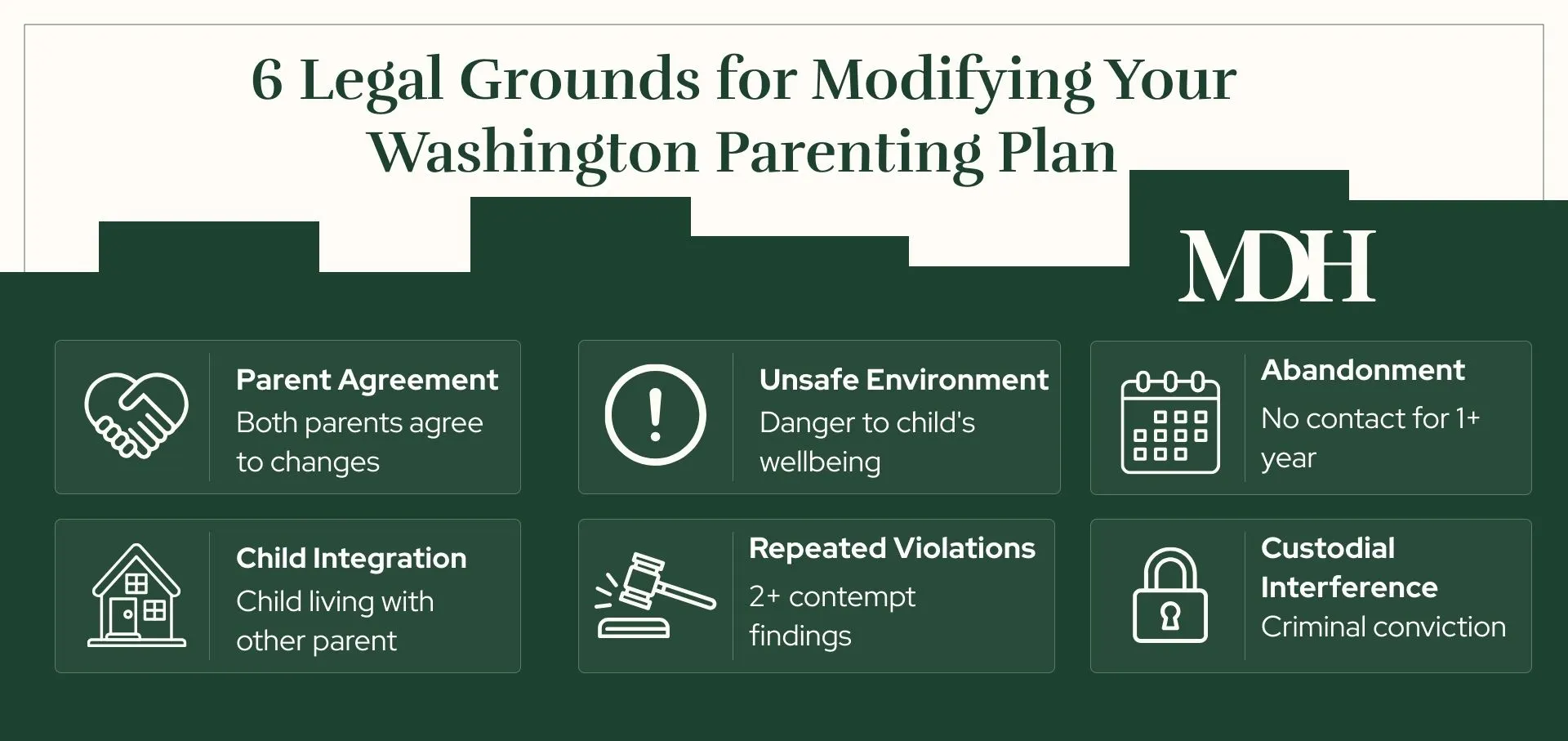
The cornerstone of Washington's modification law is RCW 26.09.260, which requires proving a "substantial change in circumstances" since the final parenting plan was established. "Substantial change" means more than mere simple things — it must be significant, ongoing, and affect the child's welfare in order to be properly considered.
Valid reasons for modification include:
- Mutual agreement: When both parents agree to changes, courts typically approve modifications more readily, often within a reasonable time of 3 to 4 months.
- Child integration: The child has been living with the petitioning parent with the other parent's consent, representing a substantial deviation from the current parenting plan.
- Detrimental environment: The child's present residential placement poses risks to their physical, mental, or emotional health.
- Repeated non-compliance: The non-moving party has been found in contempt of court at least twice within three years for violating residential time provisions.
- Custodial interference: A parent has been convicted of custodial interference in the first or second degree.
- Voluntary failure: A parent voluntarily fails to exercise residential time for one year or longer.
Major vs. Minor Changes: Why This Distinction Can Save You Thousands
Understanding whether your situation requires a significant modification or a minor modification determines everything from the burden of proof to timeline and costs.
Major Modifications
A major modification involves:
- Changing the child's primary residential schedule
- Increasing residential time by more than 24 full days per calendar year
- Altering which parent has primary custody
These require proving that the current parenting plan environment is detrimental to the child or that factors established in RCW 26.09.260 exist.
Minor Modifications
A minor modification includes:
- Adjustments not exceeding twenty-four additional days annually
- Changes due to a parent's involuntary change in work schedule
- Modifications for extended vacations or religious holidays
- Adjustments when the residential time period exceeds ninety overnights per year
Minor modifications face a lower threshold, showing the change serves the child's best interest without proving detriment.
Your 5-Step Roadmap Through Washington's Modification Process
Successfully modifying your parenting plan requires following Washington's specific legal procedures carefully.
Step 1: Evaluate Your Grounds
Document everything supporting your substantial change claim:
- Keep detailed records of incidents
- Gather necessary paperwork (emails, texts, photos)
- Obtain witness statements from teachers, counselors, or other professionals
- Compile medical or school records showing the impact on the child
Step 2: Consider Working Out an Agreement First
Before filing, attempt to resolve disputes with the other party:
- Propose changes in writing to the responding party
- Consider mediation to reach an agreement
- Document all communication attempts
- If parents agree, the process becomes significantly simpler
Step 3: File Your Petition
File the appropriate forms:
- Petition to Change Parenting Plan (FL Modify 601)
- Proposed parenting plan with your requested changes
- Supporting declarations explaining the substantial change
- Additional documents supporting your case
Filing fee varies:
- Same county, existing case number: $56
- Different county or new case: $260
- Fee waivers are available for qualifying low-income parents
Step 4: Serve the Other Parent

Proper service ensures the other parent receives notice:
- Use a process server or sheriff
- Cannot serve papers yourself
- File proof of service with the court
- Allow proper response time (typically 20 days)
Step 5: Prepare for the Adequate Cause Hearing
The adequate cause hearing is your case's critical first hurdle.
The Gatekeeper Hearing That Decides Everything
This preliminary hearing acts as a gatekeeper, determining whether your case has sufficient merit to proceed. The judge reviews whether you've demonstrated adequate cause for modification.
What Happens During the Hearing
- Both parties present brief arguments (5 to 10 minutes each)
- Judge reviews the filed petition and supporting evidence
- Court finds whether adequate cause exists
- Decision of the court is typically made immediately
Possible Outcomes
- Adequate cause found: Case proceeds to settlement conference or trial.
- No adequate cause: Current motion dismissed (can refile with new evidence).
- Partial adequate cause: Only specific issues move forward.
Preparing for Success
- Organize evidence chronologically
- Prepare a concise oral argument
- Focus on the significant change and the child's needs
- Bring copies of all forms and evidence
- Dress professionally and arrive early
Changing a Parenting Plan Is Complex. Call Us for Help.
Our experienced attorneys know exactly what judges are looking for because we’ve practiced law in front of them for years. We'll help you organize compelling evidence and craft arguments that meet Washington's legal standards.
What Evidence Wins Cases (And What Doesn't)
The difference between a successful modification and a dismissed case often comes down to the quality and organization of your evidence. Washington courts require concrete proof showing how the substantial change directly impacts your child's well-being, not just inconveniences to parents. Understanding what evidence carries weight can save you months of time and thousands in legal fees.
When Relocation Changes Everything
Relocation triggers more modifications than any other single factor. Washington requires 60 days' notice with specific location details and a proposed new residential schedule. The other parent has 30 days to object, potentially leading to a hearing on 11 factors outlined in the statute.
Timeline and Cost Considerations
Most parents underestimate both the time and financial investment required for parenting plan modification. While every case differs, understanding realistic expectations helps you plan effectively and avoid costly surprises midway through the process.
Realistic Timeline Expectations
Uncontested modifications (parents reach an agreement):
- Filing to completion: 2 to 3 months.
- Adequate cause hearing: 4 to 6 weeks after filing.
- Final orders: 2 to 4 weeks after agreement.
Contested modifications (requiring trial):
- Initial filing to trial: 6 to 12 months.
- Discovery period: 3 to 6 months.
- Trial setting: 4 to 8 months from adequate cause.
- Temporary orders are possible while the case is pending.
Complete Cost Breakdown
Court costs:
- Filing fee: $56 to $260.
- Service fees: $75 to $150.
- Copying/administrative: $50 to $100.
Professional fees:
- Attorney hourly rates: $200 to $400.
- Flat fee representation: $2,500 to $15,000.
- Guardian ad litem (if appointed): $2,000 to $5,000.
- Mediation: $200 to $400/hour.
Additional expenses:
- Parenting evaluation: $2,500 to $5,000.
- Expert witnesses: $300 to $500/hour.
- Lost wages because of court appearances.
Many parents successfully modify plans without attorneys for simple, agreed-upon changes. However, contested cases or those involving child support order modifications benefit from professional representation.
Common Pitfalls That Can Derail Your Case

Even strong cases can fail due to preventable errors. These common mistakes frequently undermine modification attempts, wasting months of effort and thousands in legal fees. Learning from others' failures can protect your case from similar pitfalls.
Documentation Failures
- Not maintaining contemporaneous records
- Failing to preserve text/email evidence
- No photographic documentation
- Missing crucial deadlines
Communication Errors
- Disparaging the other parent to the child
- Threatening or hostile messages
- Discussing legal proceedings with the child
- Inflammatory social media posts
Procedural Mistakes
- Making changes without court order approval
- Violating the current plan while the case is pending
- Filing in the wrong venue
- Improper service of documents
Critical warning: Even if both parents informally agree to changes, operating outside the court-ordered parenting plan can result in contempt charges. Always formalize modifications through proper legal channels.
Special Circumstances Requiring Unique Approaches
Not all modifications follow the standard timeline. Certain situations demand immediate court intervention or special handling. Understanding these exceptions can be crucial when urgent child safety issues arise or unique family circumstances require tailored approaches.
- Domestic violence cases: Courts prioritize safety through expedited protection orders, supervised exchanges, emergency temporary orders, and coordination with DV advocates. Document everything and request immediate court intervention.
- Military service: Federal and state law protect service members. Deployment isn't grounds for permanent changes, but temporary modifications are available. Parents can delegate visitation to family members during their absence.
- High-conflict situations: When cooperation is impossible, courts may order parallel parenting plans, detailed exchange protocols, Guardian ad litem appointments, and communication through court-approved apps only.
Your Child Deserves a Plan That Works. Let’s Help You Create It Today.
Modifying a parenting plan requires strategy, evidence, and careful adherence to Washington's legal requirements. Success depends on proving how changes serve your child's best interests while navigating complex procedural requirements.
Don't let uncertainty delay necessary changes for your child. Hodgson Law Office has used our advanced knowledge to successfully complete hundreds of parenting plan modifications throughout Washington State. Contact us today for a confidential consultation.