-min%20(1).svg)
Gray divorce (a newish term describing divorce after age 50) is becoming increasingly common as couples reassess their relationships later in life. Whether driven by unfulfilled expectations, financial independence, or simply growing apart after decades together, ending a long-term marriage presents unique challenges that younger couples rarely face.
As experienced Spokane divorce lawyers who have guided countless clients through late-in-life separations, we understand the complexity and emotionality of gray divorce in Washington State. We'll help you understand your options so you can make informed decisions about your future.
Common Reasons for Gray Divorce in Washington State
Gray divorce refers to the dissolution of marriage among individuals aged 50 and older, a phenomenon that has doubled since 1990, according to the Pew Research Center. In Washington, a no-fault divorce state, couples can separate without proving wrongdoing, making the process more accessible for older adults seeking to end unhappy marriages.
- Empty nest syndrome: Many couples realize they stayed together primarily for their children. Once adult children leave home, partners often discover they have little in common beyond co-parenting.
- Financial independence: When spouses achieve financial independence through career success or retirement savings, they become less economically dependent on the marriage. Disagreements about retirement lifestyle create irreconcilable differences.
- Health issues and caregiver burnout: Chronic illness in one spouse can severely strain a marriage, especially when the healthy partner becomes a full-time caregiver.
- Loss of intimacy: Decades of unaddressed resentment, separate bedrooms, or emotional distance can lead one spouse to seek connection elsewhere.
- Personal growth: People change significantly over decades. When one spouse embraces new interests or identity while the other remains static, the gap becomes too wide to bridge.
- Addiction issues: Addiction problems that were tolerated for years may become unbearable in retirement, especially when a fixed income makes financial recovery nearly impossible.
These factors often accumulate over decades, leading couples to conclude that separation offers a better quality of life than remaining in an unfulfilling marriage.
Gray Divorce Statistics: Understanding the Trend
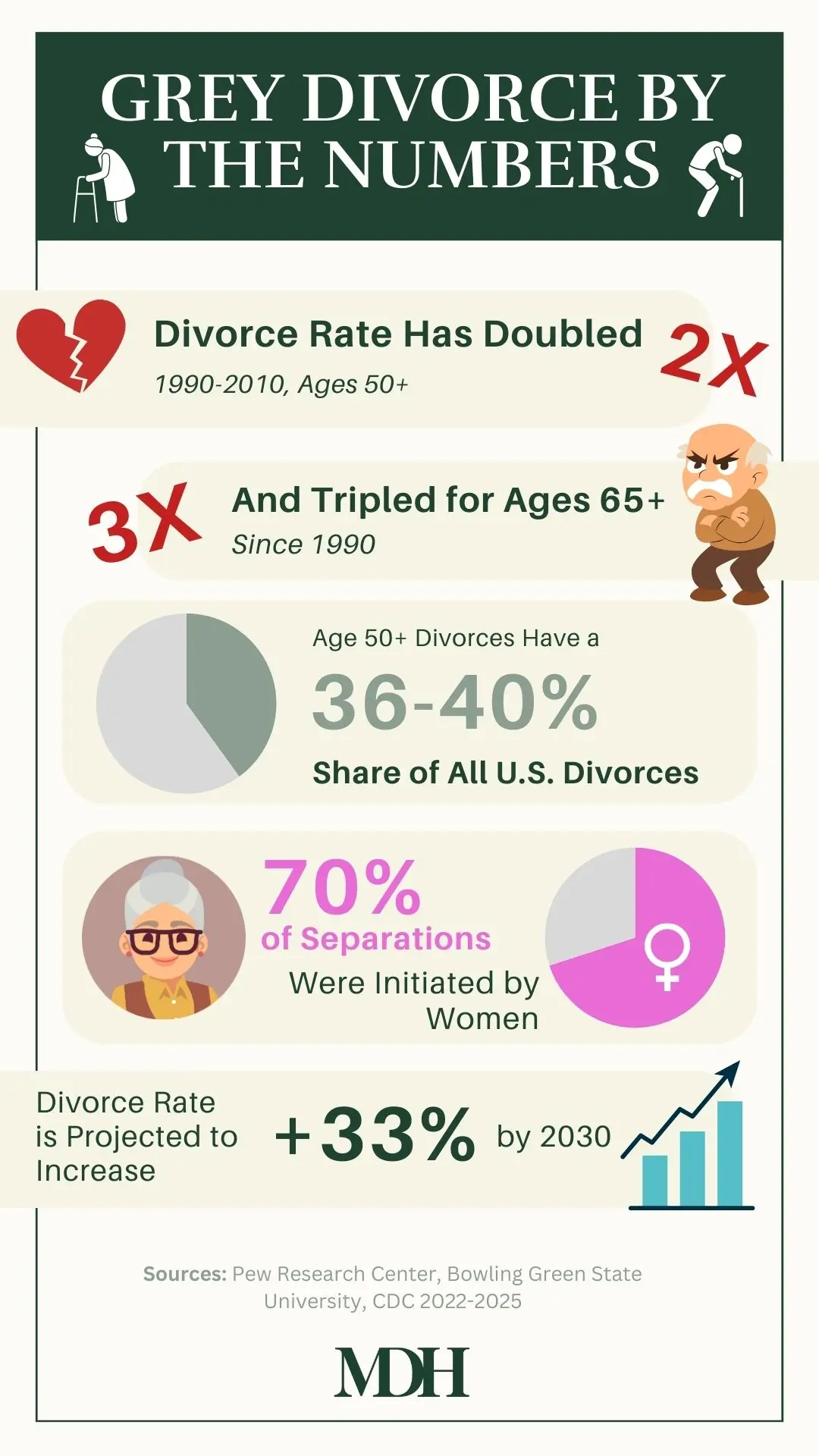
Adults aged 50 and older now account for 36% to nearly 40% of all divorces in the United States, according to Bowling Green State University research. For those aged 65 and older specifically, divorce rates have tripled since 1990, reaching approximately 15% in 2022.
Women initiate approximately 70% of gray divorces, often citing emotional fulfillment and personal growth as primary reasons. While overall U.S. divorce rates have declined to approximately 2.4 per 1,000 population, the rate for adults over 50 doubled between 1990 and 2010. Projections suggest the total number of older persons who divorce will grow by one-third by 2030.
The Unique Challenges of Gray Divorce
Gray divorce creates distinct challenges due to age, complex asset accumulation, and life stage considerations.
Division of Retirement Assets
Washington's community property laws apply to retirement accounts accumulated during marriage. Dividing 401(k)s, IRAs, pensions, and Social Security benefits requires Qualified Domestic Relations Orders (QDROs) to avoid tax penalties. Assets meant to support one household must now fund two separate retirements.
Health Insurance and Medicare Complications
After a divorce, coverage through a spouse's plan ends, requiring reliance on COBRA (limited to 18 to 36 months) or Affordable Care Act marketplace options. Pre-existing conditions and prescription costs affect older adults more severely, making insurance continuation critical.
Social Security Benefits Impact
Divorced spouses married 10 or more years can claim spousal Social Security benefits based on their ex-spouse's earnings record without reducing the ex-spouse's benefits. Remarriage before age 60 eliminates eligibility for divorced spousal benefits.
Housing and Long-Term Living Arrangements

The family home typically represents the largest marital asset. Decisions about selling versus one spouse buying out the other carry significant implications. Long-term care planning grows more complex post-divorce, with issues such as who pays for assisted living or nursing home care if one spouse needs it.
Emotional Impact on Adult Children
Adult children often feel shocked and angry when parents divorce after decades together. One client's grown daughter asked, "If you could stay married 30 years, why can't you make it work now?" Family gatherings become complicated negotiations, creating lasting divisions.
Estate Planning Changes
Divorce requires completely updating wills, trusts, powers of attorney, and beneficiary designations. Without updated documents, ex-spouses could potentially claim assets you intended for children or other beneficiaries.
#cta_here
Problems with Gray Divorce: Why Some Couples Regret Their Decision
While divorce may seem like the solution to an unhappy marriage, it's important to understand potential downsides. These aren't reasons to stay in an abusive or deeply unhappy marriage, but genuine considerations for couples on the fence.
- Severe financial strain: Splitting one retirement fund between two households often means both spouses experience a significant lifestyle reduction. Women especially face poverty risk — their standard of living drops by an average of 45% compared to 21% for men.
- Loss of shared history: Ending a 30 to 40-year partnership means losing shared memories and family traditions. Dating in your 60s and 70s can be challenging, and many gray divorcees report profound loneliness.
- Healthcare decision-making: Spouses typically serve as healthcare proxies and make end-of-life decisions. Post-divorce, this role shifts to adult children, friends, or remains unfilled, creating vulnerability when you need support most.
- Family fractures: The impact on family unity can be permanent, with adult children often feeling like they have to choose sides, grandchildren caught in the middle, and family traditions forever changed.
- Missed reconciliation: Some couples later realize they divorced during a low point that might have improved with counseling or medical treatment for depression. One couple we worked with reconciled after filing, realizing their problems stemmed from untreated depression rather than fundamental incompatibility.
Alternatives to Divorce for Older Couples
Washington State offers several alternatives to full divorce that may better serve older couples' needs. These options preserve certain benefits while allowing separation.
Mediation

Mediation involves a neutral third-party mediator who helps couples negotiate divorce terms without litigation. This process often works well when both spouses want to avoid common divorce mistakes and maintain some cooperation
Pros:
- Lower cost than traditional divorce litigation
- Faster resolution, often completed in weeks versus months or years
- Less adversarial, preserving family relationships and allowing better post-divorce co-parenting with adult children
- Couples maintain control over outcomes rather than having a judge decide
- Confidential process, not a public court record
Cons:
- Requires both spouses to negotiate in good faith
- May not work if there's a history of domestic violence or a significant power imbalance
- Still results in divorce, not a reconciliation option
- May need separate attorneys to review mediated agreement
- One combative spouse can derail the entire process
Washington State courts provide resources for finding qualified mediators experienced in gray divorce cases.
Legal Separation
Legal separation is a court-ordered arrangement where couples remain legally married but live apart with formalized agreements about property, support, and finances.
Pros:
- Preserves health insurance coverage through spouse's plan
- Maintains Social Security spousal benefit eligibility
- Allows a cooling-off period, where the couple can either reconcile or later convert to a divorce
- Satisfies religious or moral objections to divorce
- Protects from spouse's debts without a full divorce
Cons:
- Cannot remarry while legally separated
- May cost nearly as much as a divorce to establish
- Creates an ambiguous social status, i.e., "separated but married"
- Doesn't fully sever financial ties if circumstances change
- Must go through the full divorce process later if desired
Washington legal separation laws follow similar procedures to divorce, but maintain the legal marriage.
Postnuptial Agreements

Postnuptial agreements are contracts between spouses that define property division, support, and financial responsibilities while remaining married. Unlike prenuptial agreements signed before marriage, postnups address current marital issues and can be modified as circumstances change.
Pros:
- Allows couples to stay married while protecting individual assets
- Can address specific conflicts like inheritance rights or supporting adult children financially
- Provides financial clarity without divorce
- May reduce anxiety about a future divorce if the relationship doesn't improve
- Can be modified as circumstances change
Cons:
- Requires full financial disclosure and separate attorneys (expensive)
- May feel unromantic or signal a lack of trust
- Courts can invalidate if deemed unfair or coerced
- Doesn't address emotional or companionship issues in marriage
- May give a false sense of security if the relationship continues deteriorating
Washington courts enforce postnuptial agreements but scrutinize them carefully for fairness and voluntary execution.
When Divorce Might Be the Best Option
While alternatives have merit, divorce is sometimes the necessary and healthiest choice. These situations make staying married — even if legally separated — more harmful than divorcing.
Safety Concerns and Domestic Violence
Any form of abuse, such as physical, emotional, or financial, makes divorce the most straightforward path to safety. Legal separation still ties the victim to the abuser legally and financially. One client escaped after 21 years of financial control and emotional abuse. Her ex-spouse controlled all their money, kicked her out suddenly with no resources, and changed direct deposits within hours. Ending the marriage completely was necessary for her healing and establishing safety.
Irreconcilable Financial Philosophies

When one spouse's spending, gambling, or financial irresponsibility threatens retirement security, divorce protects the responsible spouse's remaining assets. We worked with a client whose spouse spent over $50,000 on collector vehicles, while she had no income after quitting her job to move overseas.
Complete Breakdown of Communication and Trust
Marriage requires baseline respect and communication. When couples cannot have civil conversations or make joint decisions without volatility, remaining married creates ongoing trauma. One client, married for 34 years, described it perfectly: "We weren't fighting. We were just two strangers sharing a house. There was nothing left to save."
Desire for a New Committed Relationship
Some older adults meet someone new who brings genuine happiness and companionship. Legal separation prevents remarriage, and staying separated indefinitely feels dishonest to the new partner and unfair to the ex-spouse.
Fundamentally Different Visions for Retirement
When spouses want completely incompatible lives, divorce allows both people to live authentically. We've seen clients where one spouse dreamed of traveling while the other wanted to stay rooted near grandchildren. When compromise repeatedly fails, divorce frees both individuals to pursue their authentic retirement vision.

Mental Health and Well-Being Priority
Staying in a chronically unhappy marriage takes a toll on mental and physical health, causing depression, anxiety, and stress-related illnesses. At 60 to 70 years old, the quality of remaining years matters intensely. One client shared that after filing for divorce, she finally stopped having anxiety attacks for the first time in a decade.
Your Path Forward: Making the Right Decision for Your Future
Gray divorce in Washington State presents unique emotional, financial, and legal challenges that require careful consideration and experienced guidance. While ending a decades-long marriage is never easy, knowing your options, from mediation and legal separation to full divorce, empowers you to make decisions that protect your future and well-being.
As a trusted and experienced Spokane family law firm with nearly two decades of helping families, Hodgson Law Office has helped countless older couples navigate gray divorce with dignity, compassion, and strategic legal representation. Contact us today to schedule a consultation and learn how we can help you move forward with confidence into this next chapter of life.
Considering Divorce Later in Life? We Can Help.
Our Spokane divorce lawyers help older couples navigate Washington State's complex property division laws, spousal maintenance calculations, and healthcare coverage transitions while minimizing financial impact on your retirement security.
FAQ