-min%20(1).svg)
Divorce changes everything about your financial future, and few assets carry more weight than retirement benefits. With over 20,000 divorces filed annually in Washington State, thousands of couples face the challenge of dividing pension plans that represent decades of work and the promise of security in later years.
Washington follows community property laws, meaning pension funds earned during marriage typically belong to both spouses regardless of whose name appears on the account. Our Spokane property division lawyers help clients protect their retirement income while reaching fair settlements that honor both parties' contributions during the marriage.
What Qualifies as Marital vs. Separate Property
Washington law distinguishes between separate property earned before marriage and marital property accumulated during the union. The exact amount entitled to division depends on when the spouse worked and earned benefits, the type of retirement plan involved, and whether prenuptial agreements exist.
Marital Portion of a Pension
The marital portion of a pension consists of the benefits earned during the marriage, typically measured from the date of marriage to the date the marital community legally ended. In Washington, this portion is generally subject to division because courts recognize that both spouses contribute to retirement accumulation, whether through income, homemaking, child-rearing, or supporting the working spouse’s career. The marital share is usually calculated using a time-based formula that compares total years of service to years of service during the marriage.
Separate Portion of a Pension
The separate portion of a pension includes benefits earned before the marriage or after the marital community ended. This portion usually remains the property of the employee's spouse and is not divided in the divorce. However, accurately identifying and documenting the separate share is essential, as courts rely on clear evidence to distinguish it from marital property. Without proper records, a court may presume the pension is partly or entirely marital, which can significantly affect the final division.
How Washington Courts Divide Retirement Assets
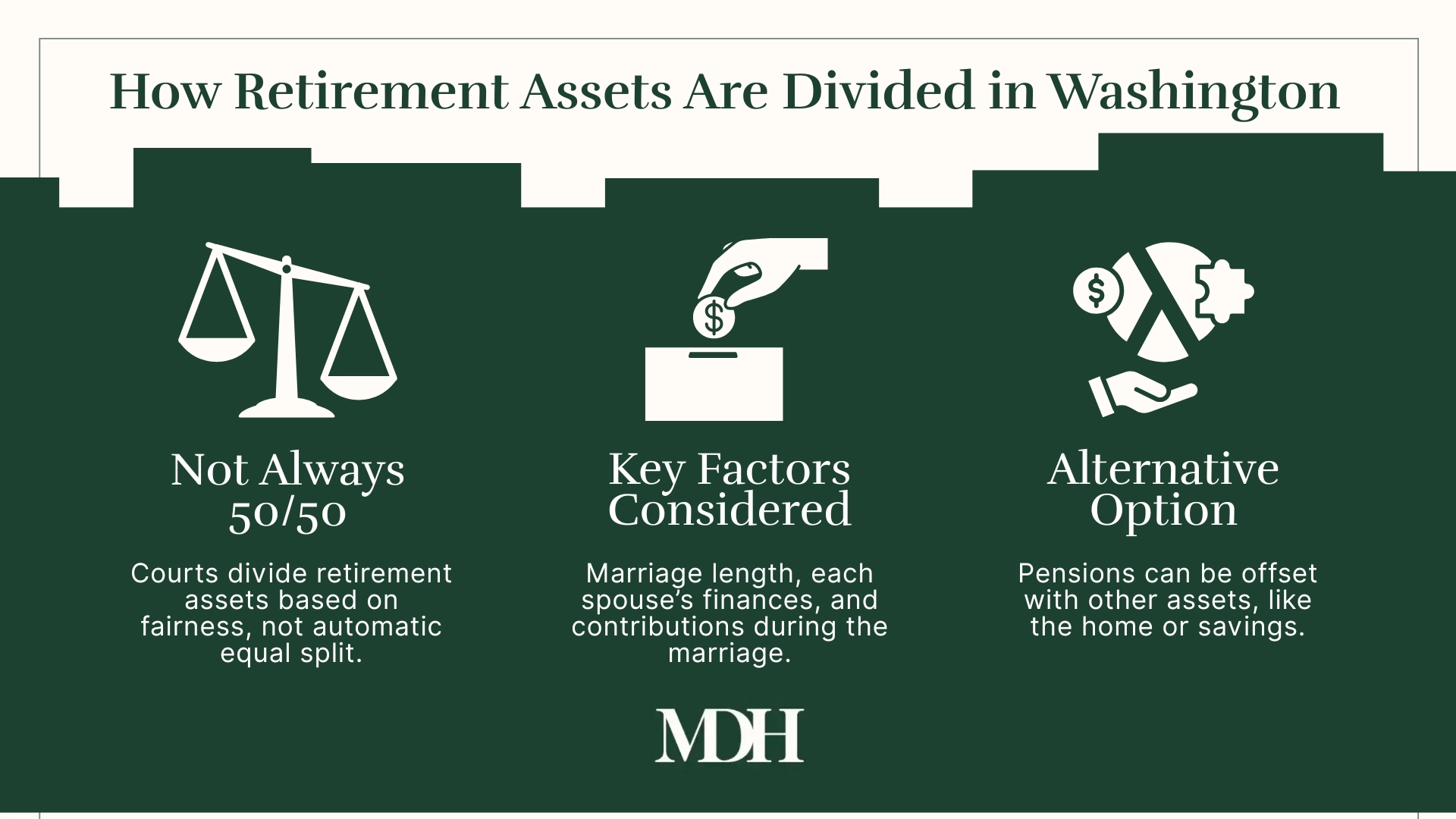
Washington courts don't automatically split pension plans 50/50, even though it's a community property state. Instead, judges consider what division would be fair and equitable based on each case's unique circumstances. The court evaluates multiple factors to determine an appropriate distribution:
- Duration of marriage: Longer marriages often lead to more balanced divisions of retirement benefits, while shorter marriages may result in smaller awards to the non-employee spouse, especially when most benefits were earned before the marriage.
- Each spouse’s financial situation: Courts consider income, earning capacity, age, health, and existing retirement savings to reach a division that supports each party’s long-term financial stability.
- Contributions to marital assets: Non-financial contributions, such as homemaking, raising children, and supporting a spouse’s career, are weighed alongside income to reflect each spouse’s role in building marital assets.
Divorcing spouses can negotiate alternatives to dividing a pension directly. A common approach is offsetting, in which one spouse receives more of the other's marital assets, such as the home or savings, while the other spousekeeps the full pension. This can simplify the settlement and reduce ongoing financial ties.
Qualified Domestic Relations Orders (QDROs) and Other Court Orders
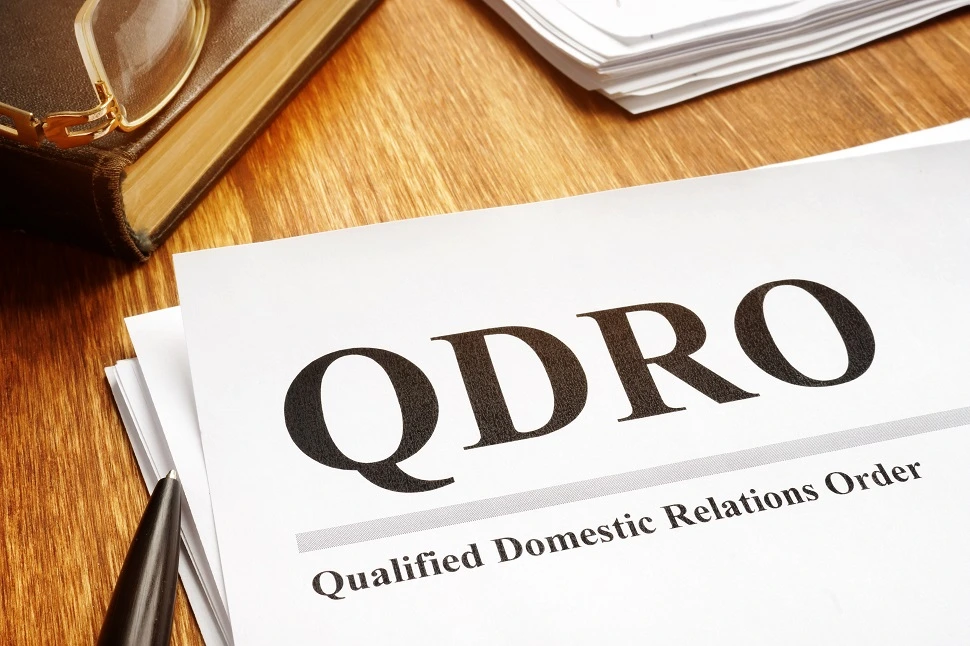
A divorce decree alone does not allow access to an ex-spouse’s retirement benefits. The type of court order required depends on the kind of retirement plan involved, and using the wrong document can delay or even prevent payment.
Qualified Domestic Relations Orders (QDROs)
Most employer-sponsored qualified retirement plans require QDROs for division, including:
- Defined benefit plans: Traditional pensions promising specific monthly payments during retirement.
- 401(k) plans: Employee contribution accounts with potential employer matching.
- 403(b) plans: Similar to 401(k)s but for nonprofit and education employees.
- Federal employee retirement plans: These follow special rules under different regulations.
Individual retirement accounts (IRAs) don't require a QDRO, but still require proper court orders to transfer funds without tax penalties during divorce proceedings.
Important consideration: Working with both a divorce attorney and a financial advisor ensures the QDRO is drafted correctly and protects your rights to retirement income.
Federal, Military, and Other Non-QDRO Plans
Federal civilian retirement plans under CSRS and FERS do not use ERISA QDROs; instead, they require court orders that meet Office of Personnel Management standards. The federal Thrift Savings Plan follows its own procedures. Military retirement is governed by separate rules, with the 10-year rule affecting only DFAS direct payment, not a court’s authority to divide the pension. IRAs do not require QDROs, but must be transferred under proper court orders to avoid taxes and penalties.
#cta_start
Need Guidance on Pension Division?
Our attorneys protect your financial future through strategic negotiation and retirement asset analysis.
Schedule a 30-minute consultation for $300
#cta_end
Protecting Your Retirement Benefits During Divorce
Taking proactive steps helps safeguard your pension while working toward a fair resolution. Gathering complete records of all retirement plans becomes the foundation of protecting your interests. This documentation proves which portions accumulated before versus during the marriage and helps actuaries calculate accurate values.
Essential documents to collect include:
- Annual benefit statements: These show current account balances, contribution history, and projected retirement benefits, providing a comprehensive picture of the pension's growth over time.
- Summary plan descriptions: Official documents from the pension plan administrator that explain how the plan works, vesting schedules, distribution options, and survivor benefit provisions available to former spouses.
- Employment records: Pay stubs, W-2 forms, and employment verification letters that establish when your spouse began working and earning pension credits, helping separate marital from pre-marital contributions.
- Previous divorce decrees: If this isn't a first marriage, prior court orders may affect current pension division, particularly if previous QDROs already allocated portions of the retirement benefits to another former spouse.
Traditional pensions that promise specific monthly payments require actuarial calculations to determine their present value, taking into account factors such as life expectancy, interest rates, and payout options. Plans like 401(k)s are easier to value since they show current account balances, though you still need to determine which contributions occurred during the marriage. Dividing retirement accounts can trigger taxes and penalties if handled incorrectly. Working with a divorce attorney and financial advisor helps ensure the process is done properly and avoids costly mistakes.
Special Circumstances Affecting Retirement Division

Certain situations can change how retirement benefits are divided in a Washington divorce. These factors may result in an unequal split or limit a spouse’s ability to claim a share of the other’s pension, making advance planning especially important.
- Short marriages: When a marriage lasts only a few years, courts may award little or no pension benefits to the non-employee spouse, particularly if most retirement income was earned before or after the marriage.
- Prenuptial agreements: Valid prenuptial agreements can override community property rules and control how retirement assets are handled in a divorce.
- Survivor benefits: A former spouse may be entitled to survivor benefits if they are properly addressed in the QDRO or court order, as some plans require specific elections to preserve these rights.
- Social Security benefits: Divorced spouses may qualify for Social Security benefits based on an ex-spouse’s work record if the marriage lasted at least 10 years, they are age 62 or older, and they are unmarried. These benefits do not reduce the ex-spouse’s payments.
Understanding these special circumstances helps prevent surprises and protects long-term financial security. Addressing retirement benefits, survivor rights, and Social Security eligibility during divorce negotiations ensures that important protections are not overlooked.
Common Mistakes and Payment Timelines
Several costly errors can jeopardize your retirement income or create lasting financial complications during divorce proceedings. Accepting a cash buyout without properly valuing pension benefits often shortchanges the non-employee spouse, as immediate lump sums rarely match the lifetime income stream a pension provides.
#spoilers_start
Failing to Obtain Proper Court Orders
Failing to obtain proper court orders after the divorce is finalized may mean you never receive your entitled portion, since plan administrators require these separate orders beyond the divorce decree itself. Some people mistakenly believe that the divorce settlement alone entitles them to pension payments, only to discover years later that, without a QDRO or an appropriate court order filed with the plan administrator, they have no legal mechanism to access the benefits.
When Payments Actually Begin
Payments typically don't begin until the employee's spouse reaches retirement age, even if you divorced years earlier. The QDRO or court order specifies the exact timing and payment method — whether you'll receive direct monthly checks from the pension plan, a percentage of your ex's monthly benefit, or a lump sum transferred to your own retirement account. This waiting period can span decades for younger couples, making proper documentation and clear court orders essential to protect future claims.
Modifying Agreements After Divorce
Once the divorce decree is final and court orders are in place, changing the pension division becomes extremely difficult. Courts rarely modify these orders unless both parties agree or significant errors occurred in the original calculation. This permanence underscores why getting it right during initial divorce proceedings is so important. Rushing through property division without fully valuing retirement benefits can leave you stuck with an unfair settlement you can't fix later.
#spoilers_end
Secure Your Retirement Rights in Divorce
Retirement benefits require careful attention during divorce proceedings, as mistakes can significantly impact your financial security for decades. Properly valuing pension plans, obtaining the correct court orders, and negotiating fair divisions protects your interests while ensuring equitable treatment of these valuable marital assets built during your marriage.
At Hodgson Law Office, our Spokane family attorneys have helped countless clients navigate complex property division involving pension benefits and other retirement accounts. We work with financial advisors and actuaries to accurately value your retirement assets and negotiate settlements that protect your long-term security. Contact us today to discuss your divorce and ensure your pension rights are fully protected.
FAQ