
-min%20(1).svg)
In Washington State, the Division of Child Support (DCS), a part of the Department of Social and Health Services, stands ready to assist you in enforcing child support orders. However, as our experienced Spokane child support attorneys know, many parents benefit from professional legal assistance throughout this process.
Let us help you understand the enforcement process, your legal obligations, and how professional legal assistance can ensure your child receives the support they need.
The Importance of Child Support Enforcement
When a non-custodial parent fails to pay court-ordered child support, it can create significant hardships for the custodial parent and the child. Our team has seen several reasons explaining how crucial enforcing child support orders can be:
- Financial stability: Regular support payments help maintain a stable environment for the child, covering essential needs like food, shelter, and clothing.
- Educational opportunities: Child support can contribute to educational expenses, ensuring the child has access to necessary resources for learning and development.
- Healthcare coverage: Many child support orders include provisions for medical support, ensuring the child has access to necessary healthcare.
- Fairness and responsibility: Enforcement ensures that each parent contributes to their child's upbringing, promoting a sense of shared responsibility.
Child support is more than just a financial transaction — it's a legal obligation that directly impacts a child's quality of life.
Understanding the Enforcement Process
While the Division of Child Support plays a role in enforcing child support orders in Washington state, an experienced attorney can often navigate the system more effectively.
Key Steps in Support Enforcement

The process begins with locating the non-custodial parent who owes support. DCS maintains databases and works with other states to track down parents who have moved or are attempting to avoid their obligations.
Establishing and Modifying Orders
Once located, DCS can establish paternity if needed and create or modify support orders. This ensures the support order reflects current circumstances and legal requirements.
Collection and Distribution
DCS collects support payments through various methods and distributes them to custodial parents. The agency processes millions in child support payments annually, helping families across Washington maintain financial stability.
Working with Other States
When the other parent lives in another state, enforcement becomes more complex but remains possible. The Uniform Interstate Family Support Act (UIFSA) allows Washington to work with other states to enforce support orders across state lines.
One client shared how her ex-husband moved to Arizona and avoided paying for over eight years. He quit jobs when employers tried to garnish wages and started accepting payments through apps like Venmo to avoid detection. Through interstate cooperation and persistent enforcement efforts, these cases can still result in collection.
Child Support Enforcement Methods in Washington State
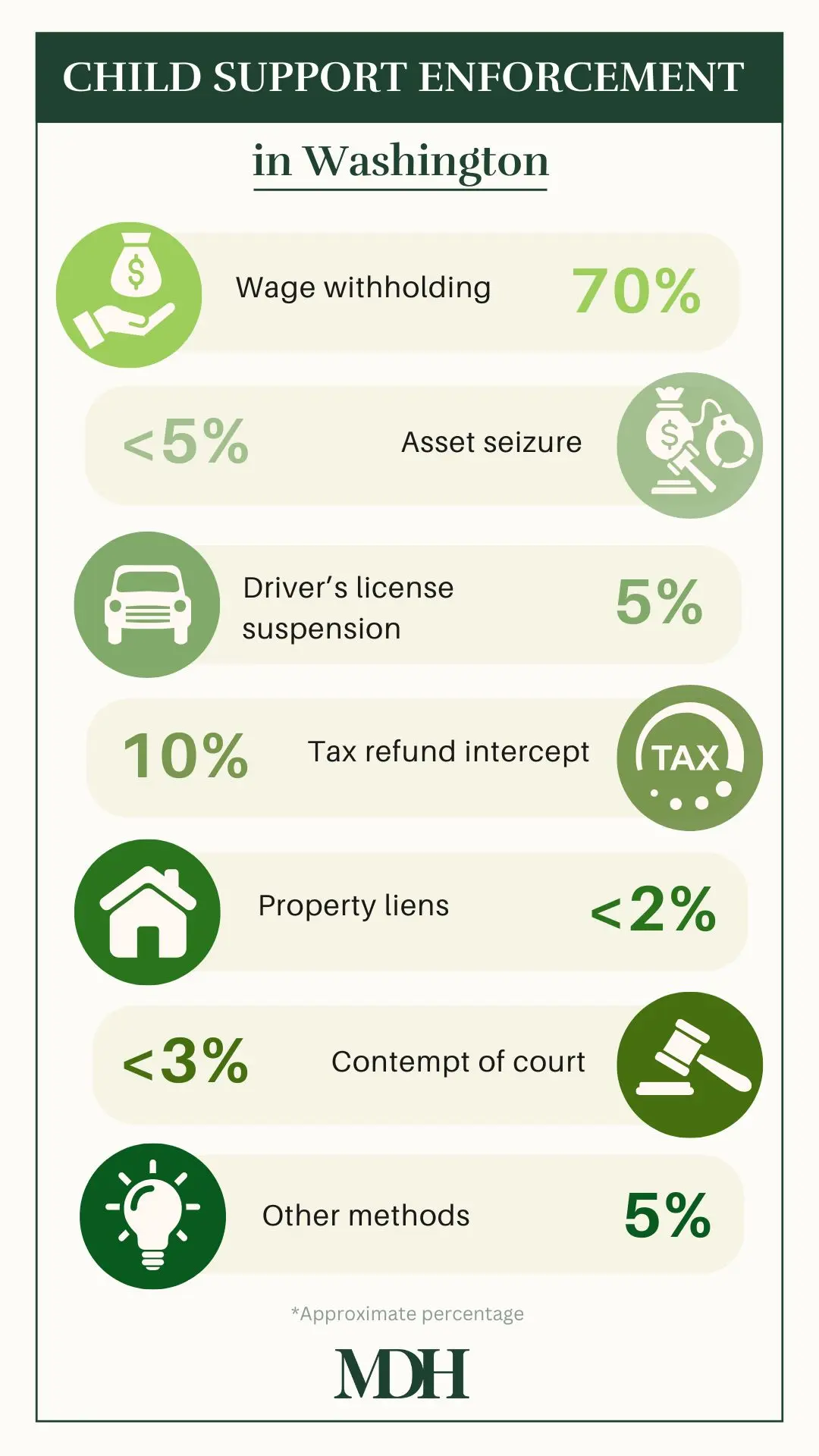
When a non-custodial parent falls behind on child support payments, Washington state law offers several enforcement methods to help collect delinquent support. Understanding these methods can help you navigate the process effectively.
Wage Withholding
The court can order the non-custodial parent's employer to withhold support payments directly from their paycheck. This remains the most effective collection method, accounting for approximately 70-80% of successful cases.
Asset Seizure
In some cases, assets such as bank accounts, safety deposit boxes, or other personal property may be seized to satisfy unpaid support. This approach is reserved for particularly difficult cases where other enforcement measures have failed.
Tax Refund Intercept
Federal and state tax refunds can be intercepted to pay off child support debts. This method accounts for roughly 10-15% of collections and proves especially helpful for cases with considerable overdue payments.
Property Liens
Liens can be placed on real estate or personal property owned by the delinquent parent. Though used in fewer than 2% of cases, property liens target larger unpaid support amounts.
Contempt of Court
In severe cases, the court may hold the non-custodial parent in contempt, which can result in fines or jail time. Used in about 1-3% of cases, contempt proceedings are reserved for parents who willfully evade their obligations.
#cta_here
Options for Parents Without a Lawyer
Self-representation in child support enforcement cases presents significant challenges, especially when the other parent feels they can act with impunity.
Understanding Your Rights
While you can represent yourself, the complexity of enforcement procedures makes professional assistance valuable. DCS provides basic services, but navigating contempt proceedings and interstate enforcement without legal guidance proves difficult.
Available Resources
Washington offers several resources for self-represented parents:
- Family law facilitators provide procedural guidance.
- Court clerks offer forms and filing assistance.
- DCS handles basic enforcement for qualifying cases.
When Professional Help Becomes Essential
Consider hiring an attorney when facing complex situations, such as interstate enforcement or when the other parent actively evades payment through sophisticated means. One parent described how her ex cashed out his 401 (k) following the divorce and started his own business using payment apps to avoid garnishment.
How to Enforce Child Support in Washington
Here are the key steps for enforcing child support, even in complex cases:
- Consult an attorney: Before taking any action, consult with a Spokane child support attorney who can assess your situation and develop a tailored strategy.
- Gather information: Compile all relevant details about the non-custodial parent, including their name, address, employer, and known assets.
- Keep detailed records: Maintain a comprehensive log of all payments (or missed payments) and communications regarding support.
- Explore enforcement options: Your attorney can guide you through various methods, from wage garnishment to more severe measures like property liens.
- Consider legal action: If initial enforcement efforts are unsuccessful, your attorney can represent you in court proceedings to enforce the support order.
- Evaluate modification needs: If circumstances have changed significantly, your attorney can help you petition for a modification of the support order.
Your attorney can help ensure you have all the necessary information at each stage so the process goes smoothly.

Understanding Child Support Enforcement Letters
Child support enforcement letters are formal communications used in the collection process. These may include:
- Notice of support owed: Informs the non-custodial parent of their current support obligation and any arrears.
- Income withholding order: Sent to the non-custodial parent's employer, directing them to withhold support from wages.
- License suspension notice: Warns of impending license suspension due to non-payment.
- Contempt warning: Notifies the delinquent parent of potential court action for non-compliance.
These letters serve as official documentation and often precede more serious enforcement actions.
Consequences of Non-Payment
Non-payment of child support carries severe consequences that extend beyond financial penalties. Parents who fail to meet their obligations face escalating enforcement actions.
- Financial penalties: Interest may accrue on unpaid support, increasing the total owed.
- Legal consequences: Contempt of court charges can result in fines or jail time.
- Asset seizure: Bank accounts, property, and other assets may be seized to satisfy the debt.
- Professional impact: License suspensions can affect employment and earning capacity.
- Travel restrictions: Passport denial can limit international travel opportunities.
- Credit impact: Reporting to credit bureaus can damage the non-custodial parent's credit score.
For detailed information about unpaid support consequences, parents should understand the full scope of potential penalties.
Resources for Parents

Both custodial and non-custodial parents can benefit from the following resources:
- Washington child support calculator: Estimate your potential child support obligations based on your income and parenting time.
- Family law facilitators in Washington: Get assistance with forms and procedures for family law cases, including child support.
- Division of Child Support: State agency handling enforcement and collection services
- Washington State Legislature: Access to child support laws and statutes.
- Washington State Courts: Court procedures, forms, and filing information.
Family law facilitators in Washington provide procedural guidance for self-represented parties. They help with forms and court procedures, but cannot provide legal advice or represent you in court. For additional assistance, contact a lawyer at Hodgson Law Office. We’ll help you locate the right resources and options for your needs.
Need Assistance with Child Support in Washington? We're Here to Help.
Navigating the child support enforcement process in Washington State can be challenging, but you don't have to face it alone. Whether you're seeking support or struggling to meet your obligations, understanding your rights and responsibilities is crucial. Remember, the ultimate goal is to ensure the well-being of the children involved.
If you're facing child support enforcement issues, don't hesitate to seek help. At Hodgson Law Office, our team of experienced child support attorneys can provide the guidance and support you need to navigate this process.
With our help, you can overcome the challenges of child support enforcement and secure a stable future for your child. Contact us today to schedule a 30-minute consultation for $300.
Struggling to Enforce Child Support?
Our experienced Spokane family law attorneys can help you understand your options and create an effective enforcement strategy tailored to your case.
FAQ
What happens if the other parent quits their job?
When a parent voluntarily becomes unemployed to avoid child support, the court can impute income based on their earning capacity. The support obligation continues, and arrears accumulate. Additional enforcement methods like asset seizure or contempt proceedings may be pursued.
Can I still get support if they're in jail?
While incarcerated parents typically cannot make regular payments, their obligation continues unless modified by the court. Support debt accumulates during incarceration. Upon release, enforcement actions resume, and payment plans may be established.
What if they pay me directly?
Direct payments without court documentation create problems. These payments may not count toward the official obligation. Always request that payments go through DCS or the court registry to maintain proper records and credit.


